


Is cardiac telerehabilitation as effective as centre-based rehabilitation? What Vitalera has demonstrated with TELECOR

A 57-year-old man is discharged from hospital after a heart attack. His cardiologist refers him to cardiac rehabilitation: 20 sessions over 8 weeks, on alternate days, at the hospital. He works, lives 40 minutes away and has no one to drive him. Until now, for many patients like him, the answer was: I guess I won't be doing the rehabilitation. The TELECOR trial has just shown that there is another option with the same results.
TELECOR is a randomized clinical trial published in September 2026 in European Heart Journal Open, the open-access journal of the European Society of Cardiology (ESC). It was led by the Physical Medicine and Rehabilitation Department and the Heart Failure Unit of Hospital Universitari Germans Trias i Pujol (Badalona), with cardiologist Antoni Bayés Genís as senior author. Its conclusion: home-based cardiac telerehabilitation delivered through the Vitalera platform is non-inferior to centre-based rehabilitation in controlling cardiovascular risk factors after an acute coronary syndrome.
According to the authors, it is the first pragmatic randomized trial to compare both models using a multidimensional composite endpoint aligned with ESC and AHA/ACC guidelines, run entirely within a public hospital and its standard care pathways. In this article we explain what was done, what was found and what it means for cardiology and rehabilitation services.
TELECOR at a glance
- What has been published: the TELECOR randomized clinical trial, in European Heart Journal Open (European Society of Cardiology, September 2026), conducted at Hospital Universitari Germans Trias i Pujol in Badalona.
- What was compared: home-based cardiac telerehabilitation through the Vitalera platform versus centre-based, in-hospital rehabilitation, in 129 patients after an acute coronary syndrome, with the same 8-week programme for both groups.
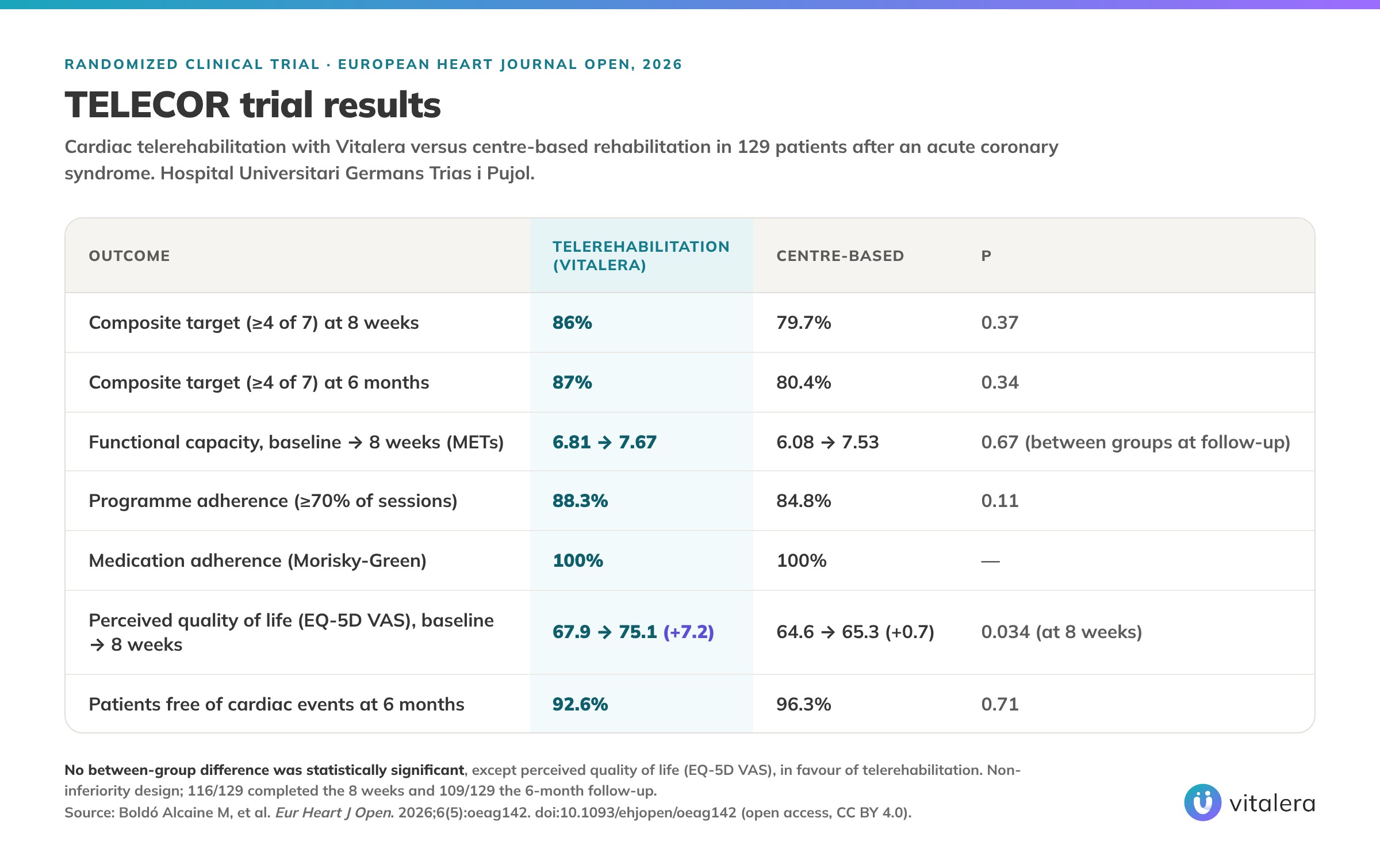
- Main result: 86% of patients in telerehabilitation met the composite endpoint for cardiovascular risk factor control at 8 weeks, versus 79.7% in the centre-based group. At 6 months, 87% versus 80.4%. Telerehabilitation demonstrated non-inferiority.
- Other results: remote follow-up at home works; similar gain in functional capacity (~1 MET) in both groups; adherence of 88.3% versus 84.8%; satisfaction score of 91.7 out of 100; better perceived quality of life in the remote group (+7.2 points on the EQ-5D VAS versus +0.7).
- Why it matters: this is evidence from a public hospital, with real patients and standard care pathways, not from a laboratory. Digital cardiac rehabilitation can widen access to a treatment that reduces mortality and readmissions, and that currently reaches only a minority of the patients who need it. The evidence of its usefulness is clear.
What were the results?
We are looking at a new model of home-based care with vitalera. Using vitalera (which provides remote monitoring) is as good as hospital-based follow-up, while also improving perceived quality of life and with a satisfaction score of 9.2/10.
86% of patients in the remote telerehabilitation group met the combined secondary prevention target, versus 79.7% in the centre-based group.
In addition, adherence to the remote programme was better, reaching 88.3%, versus 84.8% in the centre-based programme.
Telerehabilitation was non-inferior to centre-based rehabilitation on the primary endpoint and equivalent on virtually all secondary endpoints. Of the 129 randomized patients, 116 (89.9%) completed the 8 weeks and 109 (84.5%) the 6-month visit, with similar reasons for dropout in both groups. Follow-up with Vitalera is therefore just as good, safe and effective as doing it in person at the hospital, and opens up a wide range of possibilities for offering patients personalised follow-up without the need to travel.
What is cardiac telerehabilitation and why does it matter now?
Cardiac telerehabilitation is a complete cardiac rehabilitation programme (supervised exercise, therapeutic education and risk factor control) that the patient follows from home, connected live to the clinical team through a telemedicine platform and with heart rate monitoring via a wearable device. It is not an exercise video or a step-counting app: it is the same hospital programme, with the same physiotherapist, moved into the home.
Cardiac rehabilitation after a heart attack reduces mortality and hospital readmissions, and improves functional capacity and quality of life. ESC and AHA/ACC guidelines recommend it with the highest level of evidence as a pillar of secondary prevention. The problem is that it remains severely underused, especially in public health systems.
The barriers are well known: distance to the centre, rigid schedules incompatible with work, limited places and patient-related factors. The result is that a significant share of eligible patients are never referred, never enrol, or drop out before finishing. Every patient who does not complete rehabilitation is a lost opportunity to prevent a second event.
Until now, much of the evidence on telerehabilitation came from small, tightly controlled studies. The questions that matter to a healthcare manager remained unanswered: does it work inside a real public hospital, with its staff and its pathways? Which patients are candidates? Are the results sustained? The 2023 US guideline on chronic coronary disease explicitly called for pragmatic studies to prove it. TELECOR is one of them.
What exactly did the TELECOR trial study?
TELECOR compared two ways of delivering the same cardiac rehabilitation programme: at home through telerehabilitation, or in person at the hospital. It is a pragmatic, open-label, 1:1 randomized non-inferiority trial, conducted at a single centre, Hospital Universitari Germans Trias i Pujol, and registered at ClinicalTrials.gov (NCT06807658).
Patients. Between October 2021 and January 2023, adults referred to the Cardiac Rehabilitation Unit after an acute coronary syndrome in the previous two months were recruited consecutively. Clinically stable patients were included (Killip I–II, ejection fraction ≥35%, functional capacity >5 METs, no ischaemia or arrhythmia on testing), with no physical or cognitive limitations to using digital technology. 129 patients were randomized: 65 to telerehabilitation and 64 to centre-based rehabilitation. Mean age was 57.6 years, 86.8% were men and 82.2% had suffered an ST-elevation myocardial infarction. Both groups were balanced in their baseline risk factors.
Intervention. Both groups followed exactly the same programme: 8 weeks, 20 sessions of aerobic and resistance exercise on alternate days, individualised prescription based on an exercise stress test, the same progression criteria, the same therapeutic education and the same risk factor management. The only differences were the setting, the aerobic exercise modality (home circuit versus treadmill and cycle ergometer) and the heart rate monitoring system.
Primary endpoint. The proportion of patients who, at 8 weeks, met at least 4 of these 7 secondary prevention targets derived from ESC and AHA/ACC guidelines:
- Blood pressure below 140/90 mmHg
- Normal weight, or a loss of at least 5% if BMI exceeded 25 kg/m²
- Waist circumference below 88 cm in women or 102 cm in men
- LDL cholesterol below 55 mg/dL, or a reduction of at least 50% from baseline
- Smoking cessation
- Adherence to the Mediterranean diet (PREDIMED score ≥7)
- At least 6,000 steps a day or moderate-to-high physical activity according to the IPAQ questionnaire
Secondary endpoints. Functional capacity in METs, adherence to the programme and to the exercise plan, medication adherence, quality of life (EQ-5D), anxiety and depression (HADS), satisfaction and cardiac events at 6 months. The non-inferiority margin was set at 20 percentage points, with intention-to-treat and per-protocol analyses. Randomization and statistical analysis were carried out by an independent statistician.
How did telerehabilitation with Vitalera work?
The patient trained from their own living room, but they were not alone. Sessions were group-based (4 to 6 patients), live and by video call through Vitalera's secure platform. A physiotherapist led them in real time, saw every patient, recorded attendance and participation and adjusted the workload week by week, just as in the hospital gym.
Continuous monitoring. Each patient wore an activity tracker (Fitbit Inspire 2) integrated into Vitalera, so that their heart rate was monitored throughout the session and visible to the clinical team. Aerobic intensity was prescribed individually at 75–85% of the maximum heart rate reached in the stress test or, if a maximum heart rate was not reached, using the Karvonen method. In the centre-based group, monitoring was done with a chest strap.
Home-adapted exercise. The aerobic work was a supervised low-impact circuit (marching and jogging in place, side steps, knee lifts, boxing movements, stair climbing when appropriate). Strength was trained with elastic bands on the major muscle groups, in 2–3 sets of 10–12 repetitions, with resistance adjusted every week according to a 10-RM assessment and perceived exertion monitored with the OMNI-RES scale. Progression criteria were the same in both groups.
The key to the design is that the technology did not replace the clinical team: it allowed them to deliver exactly the same programme, with the same supervision and the same data, without the patient having to travel to the hospital 20 times in 8 weeks.
Oficial link: Maria Boldó Alcaine, Maria José Durà Mata, Gabriel-Fernando Sandoval Ruíz, Maria Llaberia Marcual, Marta Carceller de la Torre, Mar Domingo Teixidor, Evelyn Santiago Vacas, Antoni Bayés Genís, Telerehabilitation vs. centre-based cardiac rehabilitation after acute coronary syndrome: results of the pragmatic TELECOR randomized trial, European Heart Journal Open, Volume 6, Issue 5, September 2026, oeag142, https://doi.org/10.1093/ehjopen/oeag142
Related content
Seamless Remote Patient Integration with vitalera API and SDK
Discover how vitalera's Medical API and SDK empower IT developers and healthcare professionals to build innovative healthcare solutions, from data collected from wearables or medical devices. With FHIR compliance, real-time data, device integration, and robust analytics, transform patient care and streamline workflows. Explore now!


Our technology has partnered with Harvard Medical School.
We are proud to be working with Harvard and the Beth Israel Deaconess Medical Center. We participated in "The Future of Patient Engagement" by Harvard, where we highlighted technologies that enhance patient communication and outcomes. We extend our special thanks to the Division of Clinical Informatic for our work and efforts in CAR-T remote monitoring. The event, which included numerous thought leaders, was incredibly successful. We are eager to continue pushing the boundaries in patient engagement.

5 Things to Know About RPM and Cardiology
Remote Patient Monitoring (RPM) is revolutionizing the management of chronic cardiovascular diseases, offering substantial benefits to both patients and healthcare providers. By understanding Medicare and Medicaid reimbursement, insurance billing codes, and the technical requirements for RPM, healthcare providers can maximize the value of RPM while ensuring financial sustainability. As healthcare continues to evolve towards digital and remote solutions, RPM in cardiology will play a pivotal role in improving patient outcomes and reducing hospital readmissions.


